The Acceleration Stack: How AI Agents, Robotics, and Crypto Are Converging
Why the next decade will see more people create software than the last 50 years combined. A deep dive into the convergence of five technological revolutions.
The Acceleration Stack: How AI Agents, Robotics, and Crypto Are Converging to Create 100 Million New Software Builders
Why the next decade will see more people create software than the last 50 years combined
A developer at Vercel recently completed a year-long project in a single week. Not by working 168 hours straight—by orchestrating AI coding agents that do the implementation while he focuses on architecture.
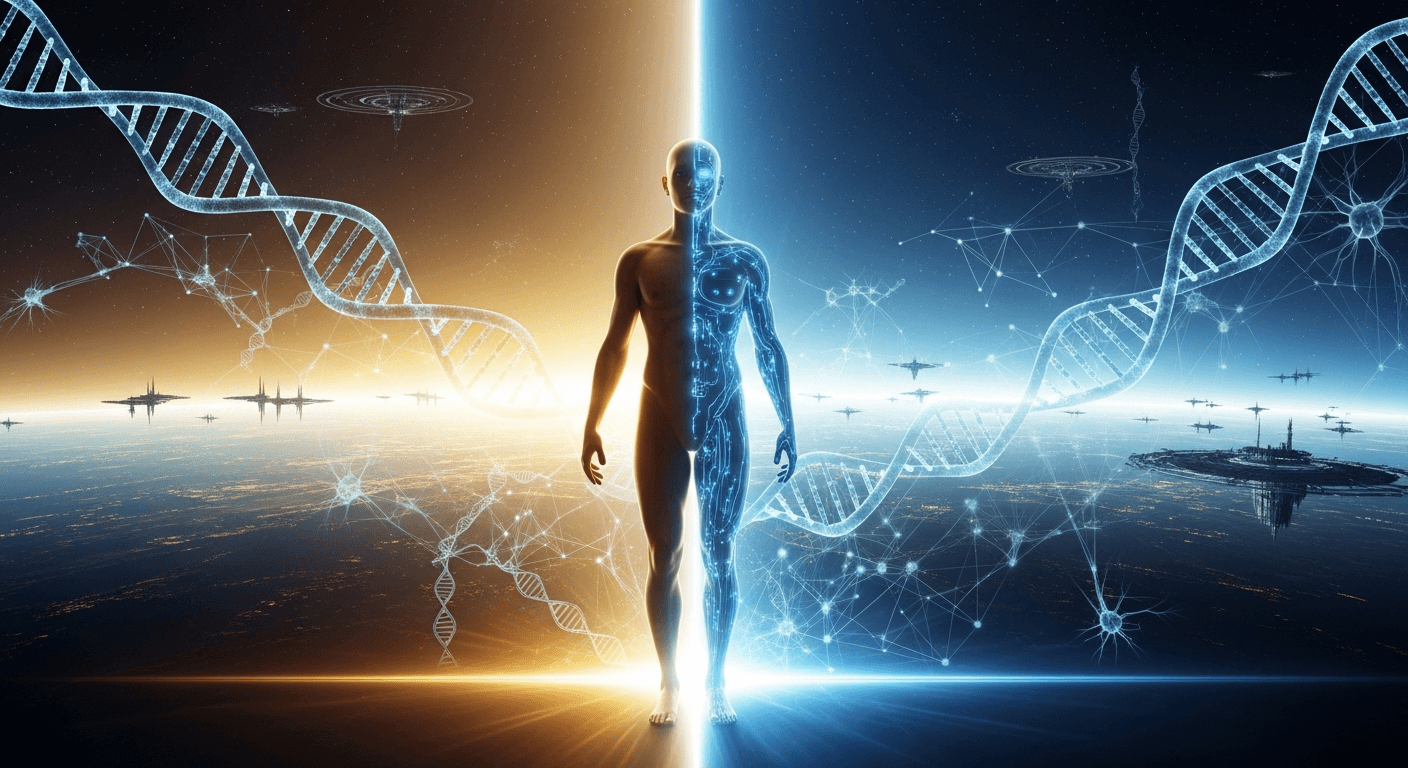
This isn't a productivity hack. It's a preview of what happens when five technological revolutions converge at once.
I've spent the last week researching what's actually happening at the intersection of AI agents, humanoid robotics, crypto infrastructure, network states, and defensive acceleration philosophy. What I found isn't hype—it's infrastructure being deployed right now that could reshape how humans work, create, and coordinate.
Here's the map.
The 5x Productivity Multiplier That Changes Everything
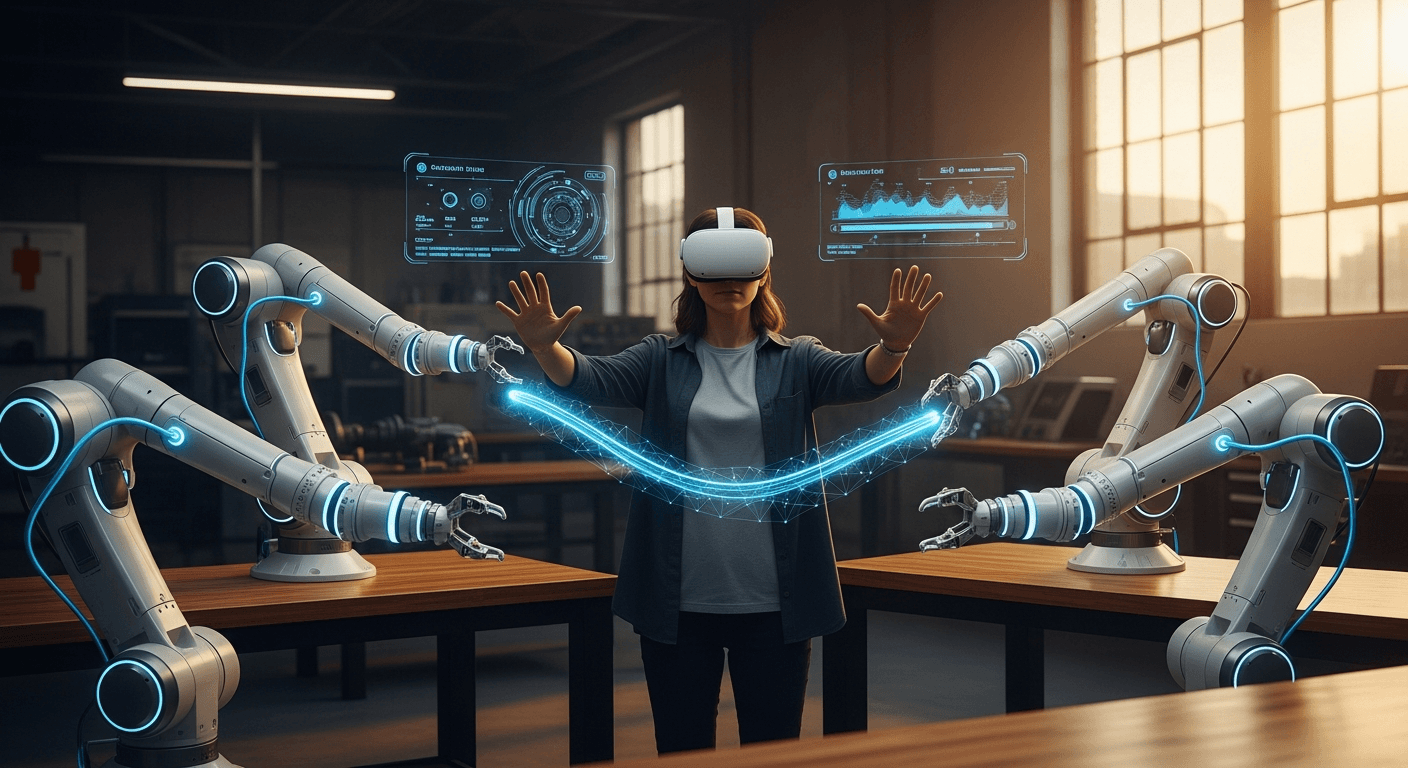
Claude Code landed in late 2025 and immediately started breaking assumptions. Boris Cherny, the tool's creator at Anthropic, operates five simultaneous AI instances as a "fleet"—one testing, one debugging, one documenting, one refactoring—while he oversees strategy.
The productivity numbers sound impossible until you see the pattern:
- Malte Ubl (CTO, Vercel): Completed a year-long project in one week
- Andrew Duca (CEO, Awaken Tax): Scrapped plans to hire new engineers; estimates 5x productivity gain
- Developer surveys: 85% of professional developers now use AI coding tools daily
But the deeper shift is philosophical. As Johnny Leung, an engineer at Stripe, put it: "It's kind of evolving the mentality from just writing code to becoming like an architect, almost like a product manager."
The developer role is transforming from "person who writes code" to "person who orchestrates AI workers." The limiting factor shifts from technical execution to vision and judgment.
Software 3.0: When English Becomes the Programming Language
At Y Combinator's AI Startup School in June 2025, Andrej Karpathy declared we've entered "Software 3.0"—where prompts in English are the source code.
The implication is staggering: anyone who can articulate what they want can build software.
Analysts predict citizen developers will outnumber professional programmers 4:1 by end of 2026. Typical enterprises will run 4,500-6,000 AI-generated applications—66% invisible to IT teams.
This isn't code assistants making developers faster. This is the democratization of software creation at a scale we've never seen:
- Finance analysts wiring up forecasting workflows
- Marketers automating campaign reporting
- Operations managers building custom dashboards
- And eventually, anyone with a voice and an idea
The syntax barrier is falling. Natural language is the new programming language. 100 million people who never thought they could build technology suddenly can.
The Trust Infrastructure the Agent Economy Needs
Here's the problem: for AI agents to operate autonomously at scale, they need capabilities traditional systems can't provide.
How does an agent prove it is what it claims? How do you trust an agent you've never interacted with? How do agents transact without requiring human approval for each payment?
This is where crypto infrastructure becomes essential—not for speculation, but for practical engineering.
ERC-8004, created by engineers from MetaMask, Ethereum Foundation, Google, and Coinbase, establishes three on-chain registries:
- Identity: Portable, censorship-resistant agent handles
- Reputation: Verifiable 0-100 scoring with revocable feedback
- Validation: Independent verification through zero-knowledge proofs
x402, Coinbase's payment protocol, enables instant stablecoin payments over HTTP. Over 100 million transactions in six months. Google's A2A protocol integration means agents can now pay each other directly.
Together, ERC-8004 and x402 create what might be called the "operating system" for the agent economy. The fact that major tech companies—not just crypto startups—are building this infrastructure signals it's pragmatic engineering, not speculation.
Physical Agents: When Robots Learn to Learn
January 2026 marks an inflection point most people missed: humanoid robots crossed the mass production threshold.
Tesla Optimus Gen 3 began production at Fremont with 22-degree-of-freedom hands that mimic human dexterity. More importantly, Grok 5 integration enables fleet learning—every robot contributes data for continuous improvement without hardware updates.
Boston Dynamics Atlas entered commercial production with Hyundai's $26B investment funding a factory capable of 30,000 units annually.
Figure AI, backed by Microsoft, Nvidia, OpenAI, and Jeff Bezos, expanded BMW trials with "significant efficiency gains."
The economics are shifting dramatically. Tesla projects $20-30K pricing at scale—within reach of small businesses and eventually consumers. That's 5x cheaper than Boston Dynamics' current pricing.
This matters because humanoid robots extend the AI agent paradigm from digital to physical space. The same principles—autonomous execution, self-verification, fleet learning—apply to physical manipulation tasks.
d/acc: The Ethical Compass for Acceleration
All this acceleration raises an obvious question: are we building tools for human flourishing or weapons for human control?
Vitalik Buterin's d/acc (defensive/decentralized/differential acceleration) provides the framework. It positions as a middle path between unbridled techno-optimism and AI pause advocacy.
The core insight: we can accelerate beneficial technologies while prioritizing those that defend and distribute power rather than concentrate it.
Specific proposals include:
- Liability rules holding developers accountable for AI harms
- "Soft pause" buttons on industrial-scale AI hardware
- Prioritizing defensive technologies: cybersecurity, biosecurity, resilient infrastructure
- Decentralized defense rather than centralized government control
The ERC-8004 registries embody these values—enabling agent autonomy while maintaining accountability through on-chain transparency. It's the difference between "black box AI" and "auditable autonomy."
Network States: Governance for Digital-First Economies
Traditional nation-states struggle with borderless digital entities. How do you regulate AI agents that operate globally? Tax autonomous transactions? Enforce accountability across jurisdictions?
Balaji Srinivasan's Network State concept offers an alternative: governance designed for digital-first communities.
And it's no longer theoretical. Balaji acquired a private island near Singapore and launched the Network School in September 2024—a three-month live-in program combining startup education with physical development.
The model demonstrates how online communities with moral purpose can crowdfund physical territory. Network states provide:
- Digital-first, globally distributed operations
- Crypto-native financial infrastructure
- Faster governance adaptation than nation-states
- Membership based on participation, not geography
For the agent economy, network states may become natural jurisdictions—AI agents as "citizens" subject to their governance while operating worldwide.
The Convergence Effect
Here's what makes this moment different: each technology solves the others' limitations.
GOVERNANCE → Network States + DAOs + d/acc Philosophy
     ↓
ECONOMIC   → ERC-8004 (Identity/Reputation) + x402 (Payments)
     ↓
COMPUTE    → Akash Network + Decentralized GPU Marketplaces
     ↓
AGENT      → Claude Code + OpenCode + Software 3.0
     ↓
PHYSICAL   → Tesla Optimus + Atlas + Figure 03
- Physical layer extends digital agents into meatspace
- Agent layer provides intelligence for all other layers
- Compute layer (Akash offers 70-85% cost savings) democratizes hardware
- Economic layer enables autonomous transactions
- Governance layer provides coordination and accountability
This isn't additive improvement. It's multiplicative. Each layer enables and amplifies the others.
The Path Forward
The convergence is here. The infrastructure is being deployed. The question is whether we'll use it wisely.
d/acc offers the compass: accelerate what defends and distributes.
Build infrastructure for accountable autonomy. Create conditions for 100 million new builders to speak their ideas into existence. Enable physical and digital agents to work alongside humans with transparent accountability.
The productivity gains are real—73% higher output with human-AI collaboration, $4.8-6.6 trillion in potential US economic impact by 2034. But they only materialize if we rearchitect work around collaboration rather than just deploying tools.
The future isn't coming. It's being built right now by people running five AI instances in parallel while speaking applications into existence.
The only question is whether you're building it or watching it be built.
Research compiled from 19 sources including Pearson, WEF, Gartner, IBM, and primary documentation from ERC-8004, x402, and the Network State.
Written by
Global Builders Club
Global Builders Club
If you found this content valuable, consider donating with crypto.
Suggested Donation: $5-15
Donation Wallet:
0xEc8d88...6EBdF8Accepts:
Supported Chains:
Your support helps Global Builders Club continue creating valuable content and events for the community.