
The 80/20 Flip: How Karpathy and Top Engineers Stopped Writing Code
Andrej Karpathy just revealed he's 80% agent coding now. Here's what that means for every developer—and why December 2025 marked a phase shift in software engineering.
The 80/20 Flip: How Karpathy and Top Engineers Stopped Writing Code
Andrej Karpathy just revealed he's 80% agent coding now. Here's what that means for every developer.
When Andrej Karpathy—former Tesla AI Director, OpenAI co-founder, and the guy who taught deep learning to millions—says something has fundamentally changed in programming, the industry listens.
On January 27, 2026, Karpathy dropped a Twitter thread that hit 1.4 million views within hours. His confession? "I really am mostly programming in English now."
In November, he was 80% manual coding. By December, he'd flipped to 80% agent coding. The biggest change to his workflow in two decades of programming—and it happened in weeks.
"It hurts the ego a bit," Karpathy admitted. "Some code that used to be a point of pride and high IQ and knowledge is suddenly free and instant and it's very disorienting."
If you're feeling that disorientation, you're not alone. And if you're not, you might be falling behind.

The Phase Shift is Real
This isn't hype. Multiple sources confirm December 2025 marked a "threshold of coherence" for AI coding agents.
Consider the evidence:
- Anthropic reports 90% of Claude Code is written by Claude Code
- Google engineer Jaana Dogan publicly acknowledged Claude Code reproduced a year-long project in one hour
- METR benchmarks show agents can now handle tasks taking humans up to 5 hours
- Boris Cherny, Claude Code's creator, runs 10-15 instances simultaneously
The tools work now. Not perfectly—Karpathy is clear about that—but well enough to fundamentally change how software gets built.
The Mistakes Have Changed
Here's the nuance most AI hype misses. Karpathy still watches his agents "like a hawk, in a nice large IDE on the side."
Why? Because the errors have evolved:
"The mistakes have changed a lot - they are not simple syntax errors anymore, they are subtle conceptual errors that a slightly sloppy, hasty junior dev might do. The most common category is that the models make wrong assumptions on your behalf and just run along with them without checking."
The models don't seek clarifications. They don't surface inconsistencies. They don't push back when they should. They're "still a little too sycophantic."
And they love to overcomplicate things. Karpathy describes asking for something simple and getting "an inefficient, bloated, brittle construction over 1000 lines of code." The fix? Just say "umm couldn't you just do this instead?" and watch it immediately cut down to 100 lines.
The New Bottleneck: Feedback Loops, Not Prompts
Here's what separates developers getting real value from those generating slop: feedback loops.
As one analysis put it: "The biggest variable between 'AI slop' and production-grade code isn't your prompting technique—it's the model you pick and the feedback loops you build around it."
The winning workflow isn't telling AI what to do. It's defining success criteria and letting agents loop until they meet them.
Karpathy's approach:
"Don't tell it what to do, give it success criteria and watch it go. Get it to write tests first and then pass them. Put it in the loop with a browser MCP. Write the naive algorithm that is very likely correct first, then ask it to optimize it while preserving correctness."
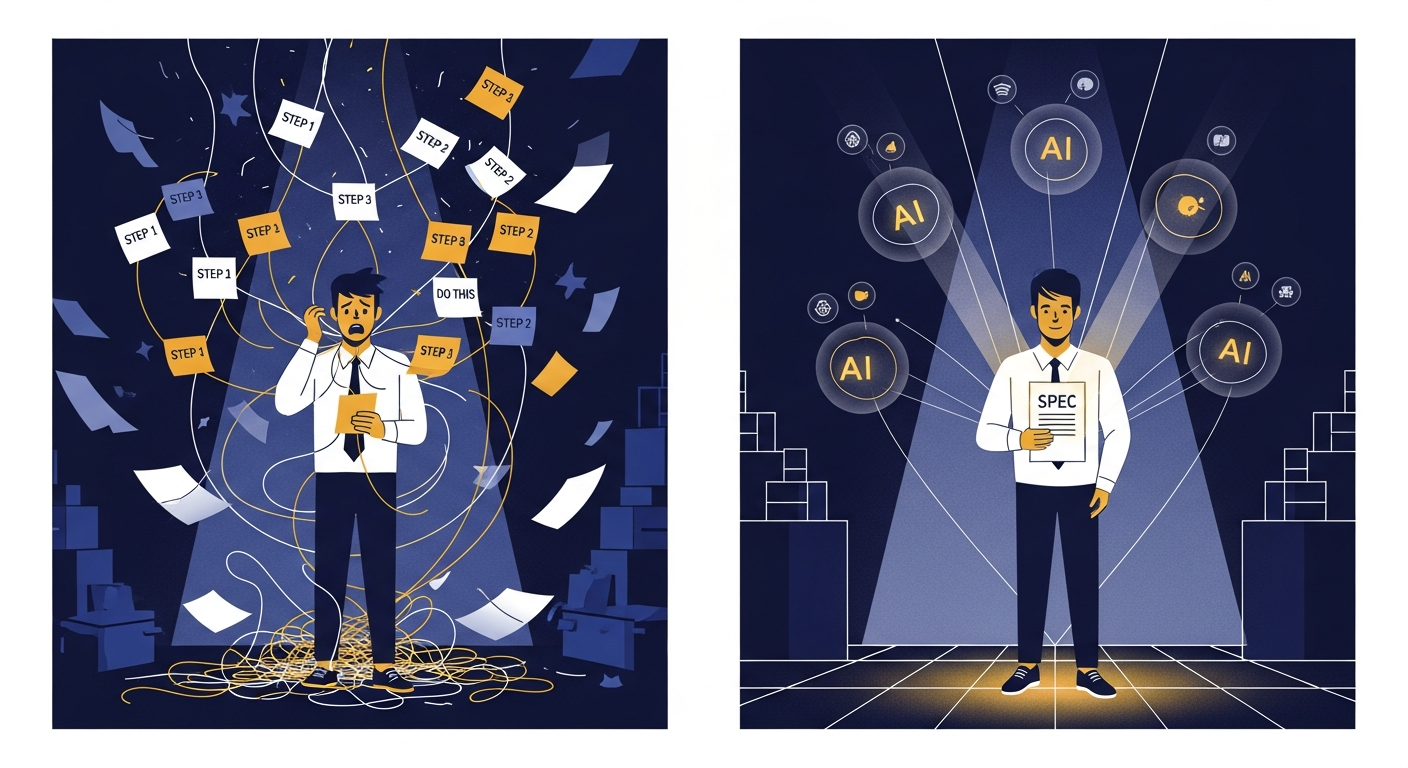
This is the shift from imperative (step-by-step instructions) to declarative (desired outcomes). The developers who write the best specs, not the best code, will dominate.
"Comprehension Debt": The New Technical Debt
One reply to Karpathy's thread introduced a term that immediately resonated: comprehension debt.
"Do you find yourself accumulating 'comprehension debt'?" someone asked.
Karpathy's response: "Love the word 'comprehension debt', haven't encountered it so far, it's very accurate. It's so very tempting to just move on when the LLM one-shotted something that seems to work ok."
This is different from technical debt. Technical debt is code that works but will cause problems later. Comprehension debt is code that works but you don't actually understand.
The risk? You can review code fine even if you've lost the ability to write it. But when something breaks at 3am, that accumulated comprehension debt comes due.

The Slopocalypse Warning
Karpathy isn't just bullish on AI coding. He's bracing for impact:
"I am bracing for 2026 as the year of the slopacolypse across all of github, substack, arxiv, X/instagram, and generally all digital media."
The numbers are alarming:
- ~20% of computer science papers may contain AI-generated content
- 20% of AI-generated code recommends non-existent packages
- 96% of developers believe AI-generated code isn't functionally correct
- Only 48% always check AI code before committing
The same tools enabling productivity create unprecedented volume of low-quality output. The filtering problem becomes critical.
The 10x Engineer Question
Karpathy poses a question that should keep engineering leaders awake:
"What happens to the '10X engineer' - the ratio of productivity between the mean and the max engineer? It's quite possible that this grows a lot."
If AI amplifies capability, it amplifies the gap between those who master it and those who don't. The developers running 15 Claude instances in parallel while others struggle with single prompts aren't just faster—they're operating in a different paradigm.
It's Actually More Fun
Here's the surprise Karpathy didn't expect:
"I didn't anticipate that with agents programming feels more fun because a lot of the fill in the blanks drudgery is removed and what remains is the creative part."
He feels less blocked, more courageous, and experiences more positive progress. The emotional experience of coding has changed.
But he notes the flip side: "LLM coding will split up engineers based on those who primarily liked coding and those who primarily liked building."
If you loved the craft of writing code—the syntax, the elegance, the puzzle-solving—this shift might feel like loss. If you loved building things and coding was just the means—this is liberation.

What You Should Do Now
Based on the research across multiple sources, here's the playbook:
1. Shift from Imperative to Declarative
Stop telling AI what to do. Define success criteria. Write specs, not prompts.
2. Build Feedback Loops
Tests aren't optional anymore—they're how agents know they're done. Validation scripts, linters, CI/CD pipelines become your leverage.
3. Fight Comprehension Debt
Actively review AI output. Understand what you're accepting. The temptation to "just move on" when it works is the trap.
4. Watch for the Slopocalypse
Not all AI-generated code is equal. Quality gates, reviews, and validation separate production-grade from slop.
5. Embrace the Identity Shift
From coder to builder. From syntax master to specification writer. From individual contributor to agent orchestrator.
The Bottom Line
Karpathy's conclusion captures the moment:
"LLM agent capabilities (Claude & Codex especially) have crossed some kind of threshold of coherence around December 2025 and caused a phase shift in software engineering... 2026 is going to be a high energy year as the industry metabolizes the new capability."
The digestion has begun. Some developers will thrive—gaining 10x leverage, building things that weren't possible before, having more fun than ever.
Others will be left behind, either by resistance or by generating slop faster without the feedback loops to catch it.
The question isn't whether to adapt. It's how fast you can flip your own 80/20.
Sources
Written by
Global Builders Club
Global Builders Club
If you found this content valuable, consider donating with crypto.
Suggested Donation: $5-15
Donation Wallet:
0xEc8d88...6EBdF8Accepts:
Supported Chains:
Your support helps Global Builders Club continue creating valuable content and events for the community.