OpenClaw Under the Hood: How the Fastest-Growing AI Repository Actually Works
A technical deep dive into the architecture that earned 135k GitHub stars in two months. The agent at its core has only 4 tools. Here's how it actually works.
A technical deep dive into the architecture that earned 135k GitHub stars in two months.
The OpenClaw repository hit 100,000 GitHub stars faster than any project in history. But beyond the hype, what's actually in the codebase? How does it work under the hood? And why is it fundamentally different from Claude Code?
I spent a week in the documentation, issues, and architecture diagrams. Here's what I found.

The Core Philosophy: Minimal Core, Infinite Edge
OpenClaw's design philosophy is radical: the smallest possible core with maximum extensibility.
At the heart is Pi, the minimal agent. Pi has exactly four tools:
- Read - File reading
- Write - File writing
- Edit - File modification
- Bash - Command execution
That's it. As Armin Ronacher noted, Pi has "the shortest system prompt of any agent that I'm aware of."
But wait—how does a 4-tool agent manage calendars, clear inboxes, and automate deployments?
Skills. 700+ of them.
The Architecture Stack
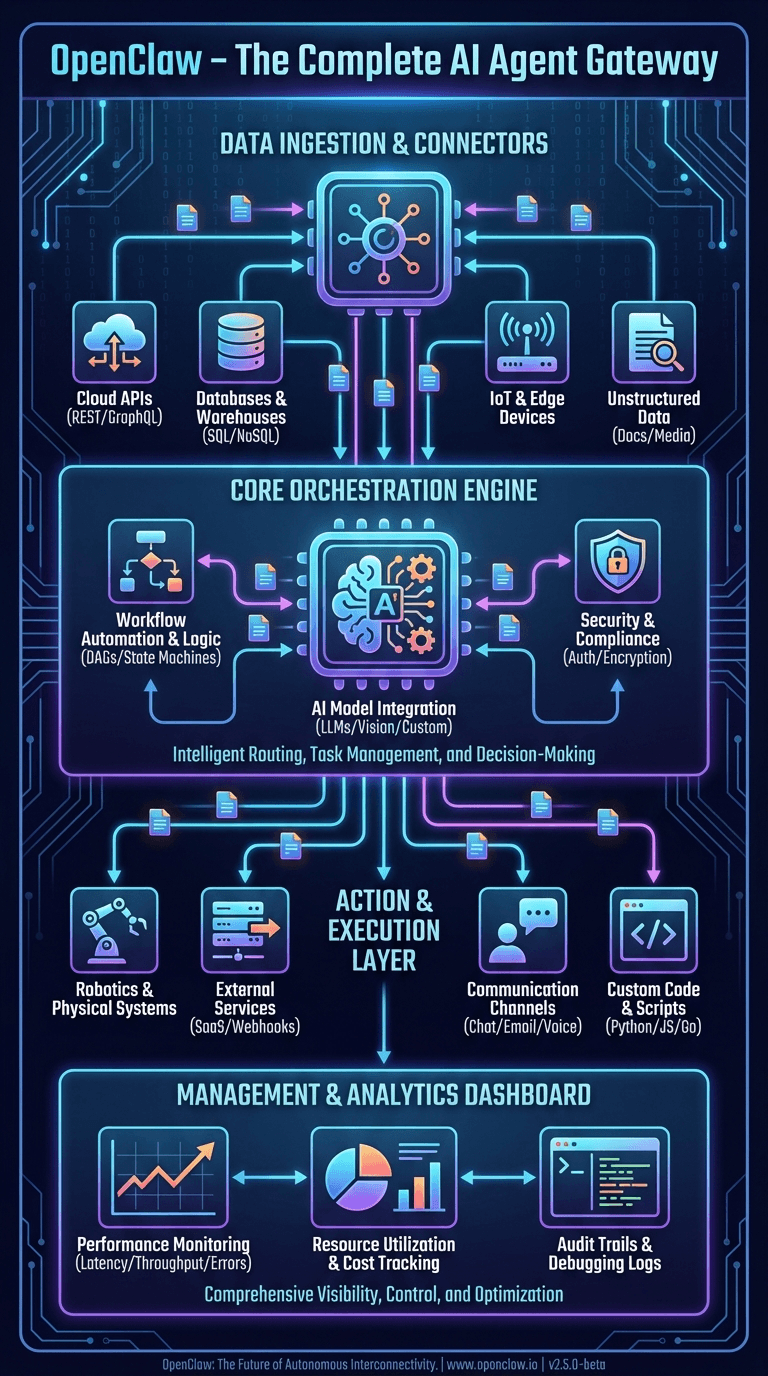
User → Channels (WhatsApp, Telegram, Discord, etc.)
              ↓
       Gateway (WebSocket @ 18789)
              ↓
         Pi Agent (4 core tools)
              ↓
         Skills (700+ via ClawHub)
              ↓
         Workspace (file-based memory)
              ↓
         Model Providers (15+ supported)
The Gateway: Control Plane, Not Product
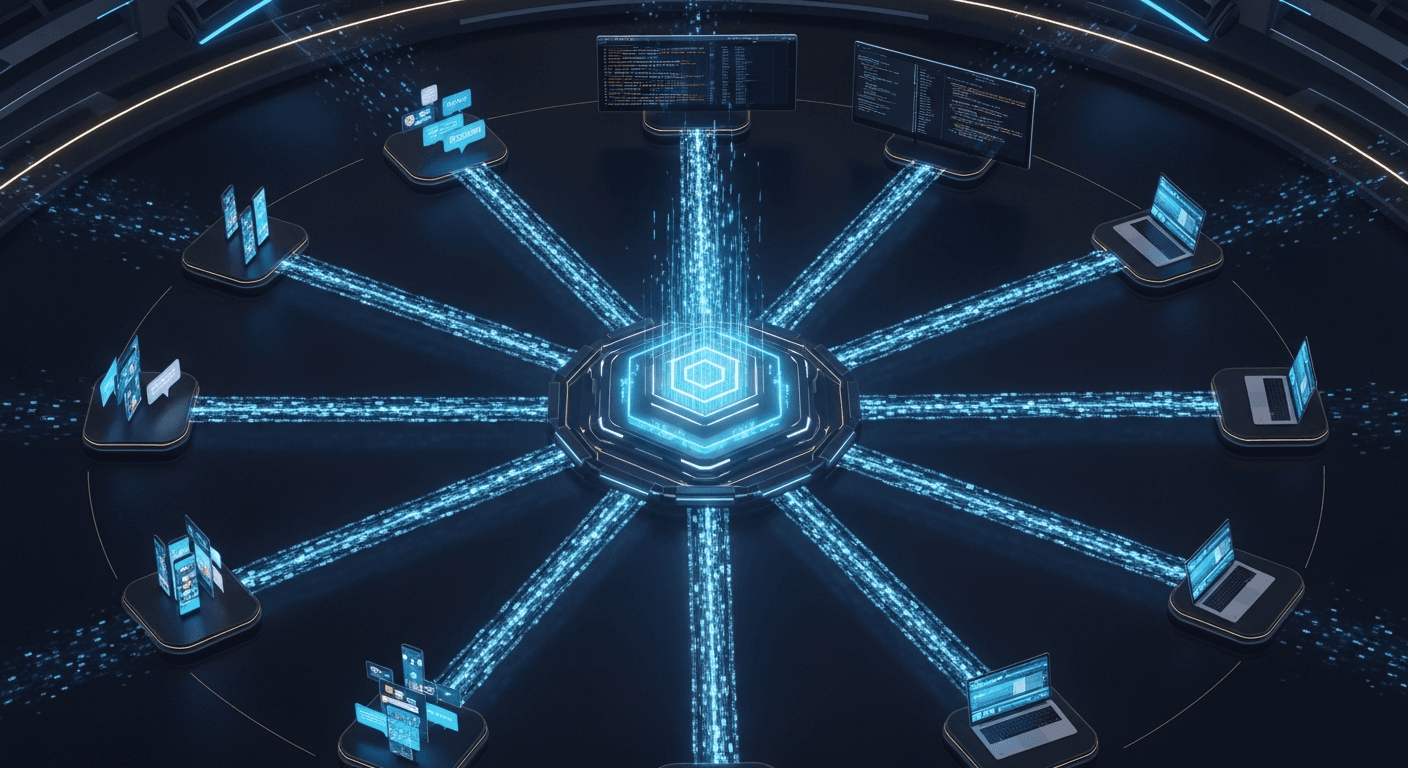
The Gateway is a WebSocket server at ws://127.0.0.1:18789. It handles:
- Session management
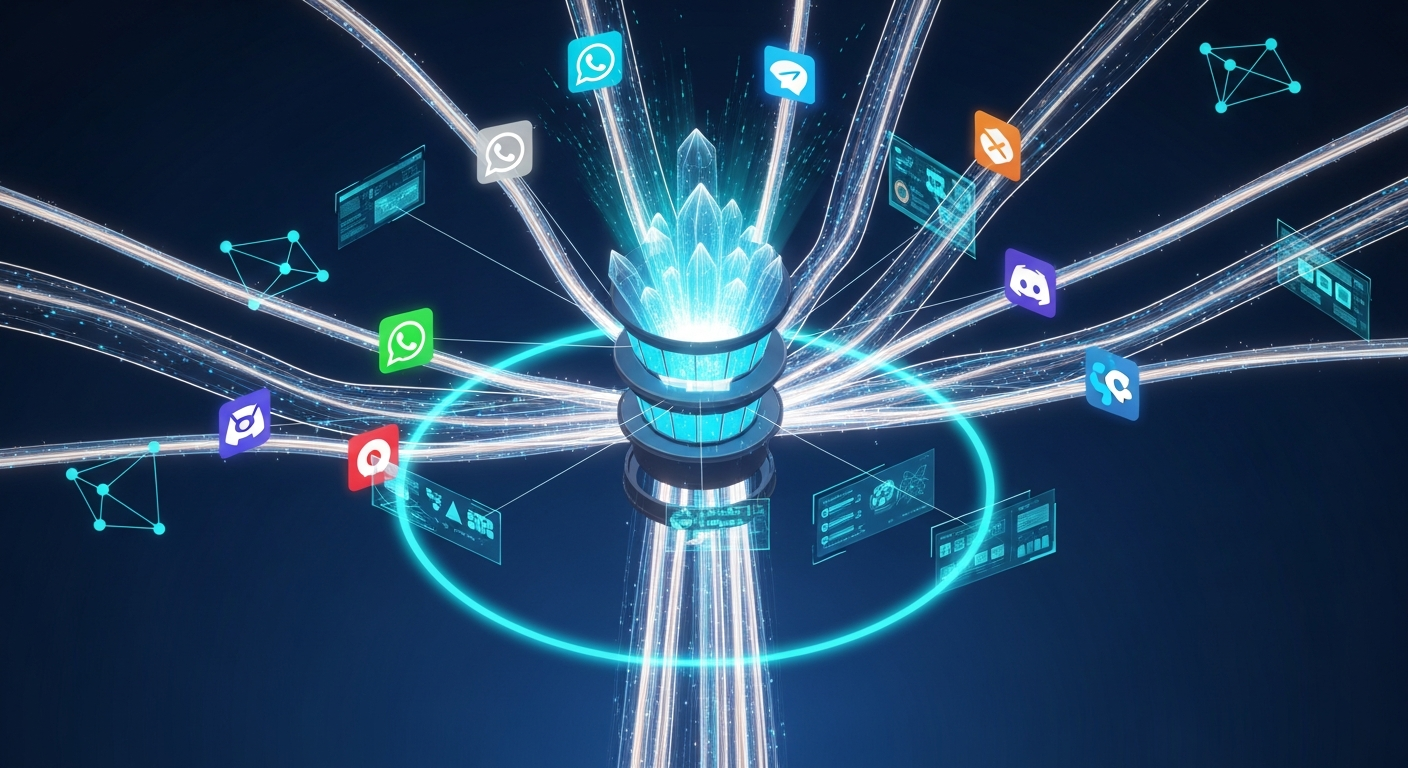
- Channel routing (12+ messaging platforms)
- Cron job scheduling
- Tool execution coordination
The documentation makes an important distinction: "The Gateway is just the control plane—the product is the assistant."
This separation matters. The Gateway is infrastructure. The intelligence comes from the model provider and skills.
The Skills System: ClawHub is npm for AI
Skills are directories with a SKILL.md file containing YAML frontmatter and markdown instructions.
---
name: email-triage
description: Automatically categorize and draft email responses
requires.env: ["EMAIL_API_KEY"]
---

# Email Triage Instructions

When the user asks you to process emails...
Three-tier loading precedence:
- Workspace skills (highest priority)
- Managed skills (
~/.openclaw/skills/) - Bundled skills (lowest priority)
ClawHub is the public registry:
clawhub install <skill-slug>
clawhub update --all

Model Provider Architecture: True Model Agnosticism
OpenClaw ships with 15+ built-in model providers:
| Provider | Key |
|---|---|
| Anthropic | ANTHROPIC_API_KEY |
| OpenAI | OPENAI_API_KEY |
| Google Gemini | GEMINI_API_KEY |
| OpenRouter | Built-in (100+ models) |
| Ollama | Auto-detected locally |
| xAI, Groq, Cerebras, Mistral | Integrated |
Custom providers work via configuration:
{
  "models": {
    "providers": {
      "my-llm": {
        "baseURL": "https://my-api.com/v1",
        "apiKey": "${MY_API_KEY}"
      }
    }
  }
}
Why this matters: You're not locked in. Run Claude today, GPT-4 tomorrow, local Llama next week. Same infrastructure, different brains.
How It Relates to Claude Code
This is the question everyone asks. Here's the honest comparison:
Security Model
| OpenClaw | Claude Code | |
|---|---|---|
| Default | Full shell access | Sandboxed |
| Execution | Acts autonomously | Asks for confirmation |
| Philosophy | User responsibility | Guardrails first |
Flexibility
| OpenClaw | Claude Code | |
|---|---|---|
| Models | 15+ providers | Claude only |
| Local models | Yes (Ollama) | No |
| Custom skills | 700+ community | Anthropic-controlled |
The Real Difference
Claude Code is a product. Anthropic controls the experience.
OpenClaw is infrastructure. You control everything.
Earlier discourse framed OpenClaw as "Claude with hands." That undersells it. OpenClaw is model-agnostic infrastructure that happens to work great with Claude.
The Heartbeat: Proactive AI
Most AI assistants are reactive: you ask, they answer.
OpenClaw can be proactive. The heartbeat feature (via HEARTBEAT.md) lets the agent wake itself up:
- Every 30 minutes, check conditions
- If threshold met, message the user
- No prompt required
"Instead of you asking 'Is the server down?', OpenClaw wakes itself up, checks the data, and messages you if a threshold is met."
This transforms the paradigm from chatbot to autonomous assistant.
The Security Reality
Here's the uncomfortable truth: 26% of community OpenClaw skills contain vulnerabilities (Cisco research on 31,000 skills).
OpenClaw's response isn't to lock things down—it's to document the risks and provide tools:
openclaw security audit --deep --fix
The philosophy: power users can manage their own security. Sandboxing is available but not default.
This is the Linux approach to AI agents. Maximum power, maximum responsibility.
The Creator's Philosophy
Peter Steinberger (PSPDFKit founder) coined the phrase: "I ship code I don't read."
His workflow:
- 5-10 concurrent agents on different features
- 6,600+ commits in January alone
- Prefers Codex for long-running tasks
- Local CI instead of remote pipelines
This philosophy permeates OpenClaw: trust the agent, extend through code, ship fast.
Getting Started: What You Need to Know
To Run OpenClaw
npm install -g openclaw@latest
openclaw onboard --install-daemon
Then open http://127.0.0.1:18789/ for the dashboard.
To Understand the Code
Key directories in the repository:
src/- Core TypeScript sourcepackages/- Modular subsystemsskills/- Bundled capabilitiesapps/- Platform-specific apps (macOS, iOS, Android)
To Contribute
git clone https://github.com/openclaw/openclaw
cd openclaw
pnpm install
pnpm build
The Bottom Line
OpenClaw's architecture is elegant in its simplicity:
- Gateway: WebSocket control plane
- Pi: Minimal 4-tool agent
- Skills: Infinite extensibility
- Providers: Model agnosticism
The 135k stars came from a real insight: some users want AI that runs on their hardware, connects to their apps, and acts autonomously—even if it's harder and riskier than managed alternatives.
Understanding OpenClaw isn't just about one project. It's about understanding what open-source AI infrastructure might look like as the field matures.
Resources: OpenClaw GitHub | Documentation | ClawHub Skills Registry
Written by
Global Builders Club
Global Builders Club
If you found this content valuable, consider donating with crypto.
Suggested Donation: $5-15
Donation Wallet:
0xEc8d88...6EBdF8Accepts:
Supported Chains:
Your support helps Global Builders Club continue creating valuable content and events for the community.