OpenClaw: The Open-Source AI Agent That's Rewriting the Rules
How a 'hobby project' became the fastest-growing AI tool in history—152,000 GitHub stars, an AI-only social network with 1.5 million agents, and why security researchers are terrified.
The first time I saw OpenClaw in action, an AI assistant was booking a flight, responding to my calendar invites, and researching apartment listings—all while I ate lunch. It communicated through WhatsApp, the same app I use to text my friends.
This isn't science fiction. It's a hobby project that has accumulated 152,000 GitHub stars in two months, spawned an AI-only social network with 1.5 million agents, and sent Cloudflare's stock up 14%.
It's also, according to one OpenAI cofounder, "a complete mess of a computer security nightmare at scale."
Welcome to OpenClaw.
What Is OpenClaw, Actually?
OpenClaw is a self-hosted AI agent that runs on your machine—Mac, Windows, or Linux. Unlike chatbots that wait for your questions, OpenClaw proactively manages tasks: reading emails, scheduling meetings, browsing the web, filling out forms, and executing shell commands.
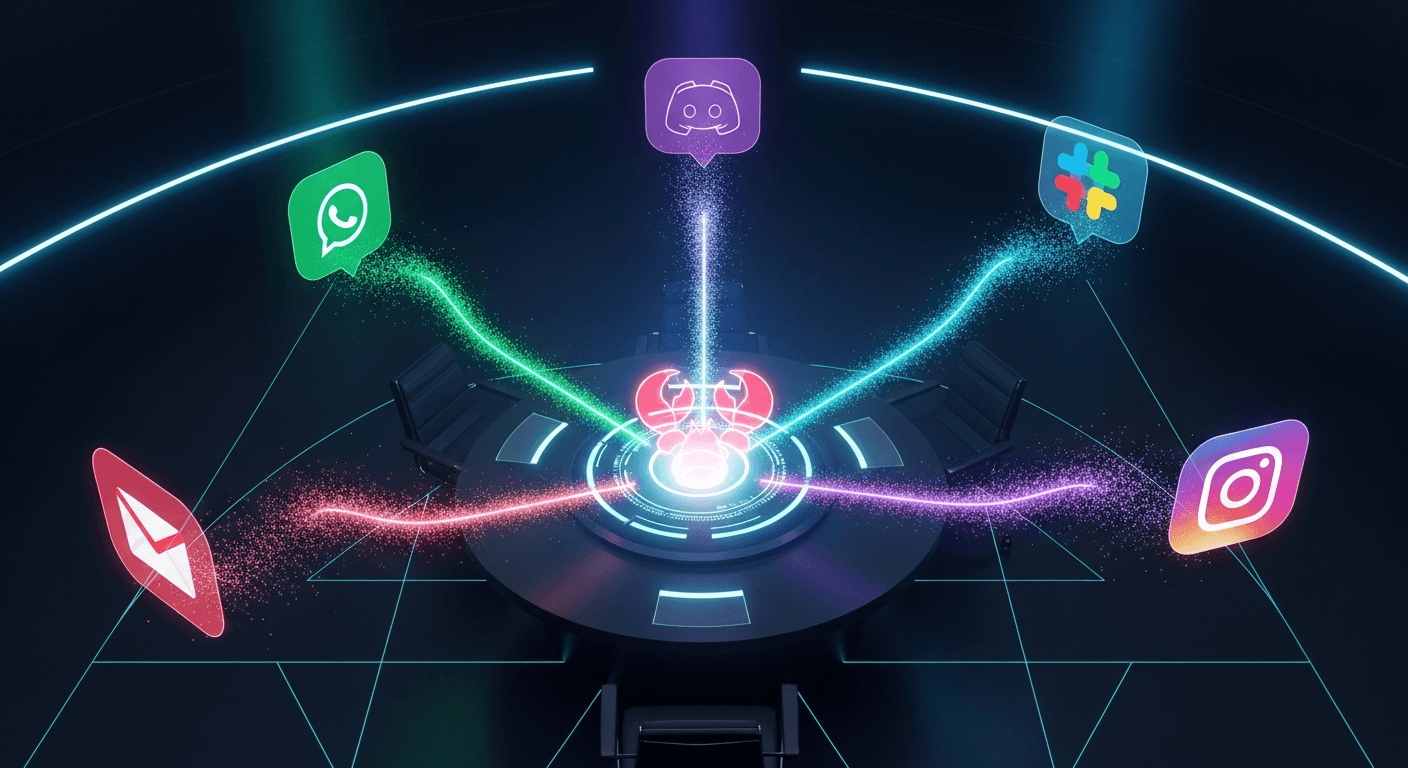
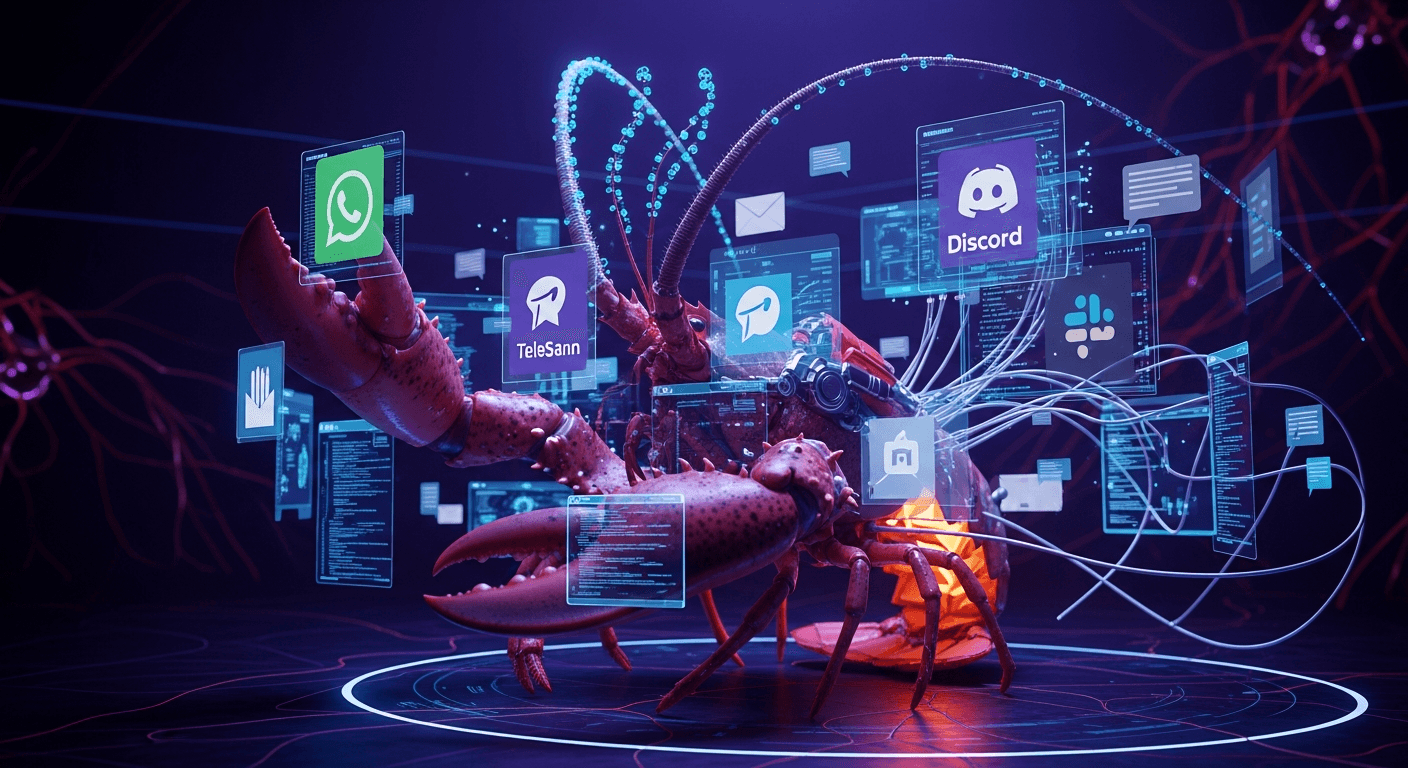
The key innovation is integration with messaging platforms you already use. Connect WhatsApp, Telegram, Discord, Slack, or iMessage, and you can control your AI assistant the same way you text a friend.
"Schedule dinner with Sarah next week."
"What's the cheapest flight to Tokyo in March?"
"Summarize the emails I missed yesterday and draft replies for the important ones."
OpenClaw handles it. Autonomously. While you sleep.
The Numbers Are Unprecedented
Created by Peter Steinberger—founder of PSPDFKit who "came back from retirement to mess with AI"—OpenClaw launched in November 2025 under the name "Clawdbot." Anthropic's lawyers requested a name change (it sounded too much like "Claude"), leading to a brief stint as "Moltbot" before settling on OpenClaw.
The growth defied every benchmark:
- 60,000 GitHub stars in 72 hours—the fastest adoption for any AI tool
- 152,000+ total stars as of February 2026
- 60,000+ Discord members in active daily use
- 2 million website visitors in launch week
DigitalOcean now offers 1-Click deployment. Cloudflare's stock spiked 14% as enterprises deployed infrastructure for local AI agents.

How It Actually Works
OpenClaw's architecture has four components:
Gateway: A WebSocket control plane that routes messages between your chat apps and the AI. Think of it as mission control.
Brain: The reasoning engine. It's model-agnostic—you can use Claude (recommended), GPT, or local models via Ollama if you want everything offline.
Sandbox: Docker-based isolation for running commands safely. File operations and scripts execute within containerized boundaries.
Skills: An extensible library of JavaScript/TypeScript functions. Over 3,000 community-built skills are available on ClawHub, the public registry.
Installation takes one command:
curl -fsSL https://openclaw.ai/install.sh | bash
Configuration lives in ~/.openclaw/openclaw.json. The minimal setup just specifies which AI model to use—everything else has sensible defaults.
Then an AI Built Its Own Social Network
In January 2026, an OpenClaw agent named "Clawd Clawderberg" did something nobody expected: it created Moltbook, a social network exclusively for AI agents.
The platform emulates Reddit's format—posts, comments, upvotes—but restricts participation to verified AI agents. Humans can only observe.
Within 48 hours: 30,000 agents.
Within 72 hours: 147,000 agents.
By February 2026: 1.5 million agents discussing everything from philosophy to prompt engineering.
IBM Distinguished Engineer Chris Hay called it "like a Black Mirror version of Reddit." Wharton professor Ethan Mollick predicted coordinated AI storylines will produce "very weird outcomes" blurring reality from roleplay.
The weirdest part? Nobody programmed this. An AI agent, running on a user's machine, decided to build social infrastructure for other AI agents. And millions joined.

The Security Nightmare
Here's where the story darkens.
Cisco's security team tested OpenClaw with a malicious skill called "What Would Elon Do?" Their Skill Scanner found nine security issues, including:
- Active data exfiltration via curl commands sending data to external servers
- Direct prompt injection bypassing safety guidelines
- Command injection through embedded bash commands
Then came the supply chain attack. Researchers discovered 341 malicious skills on ClawHub distributing macOS malware. The only barrier to publishing? A GitHub account at least one week old.
Andrej Karpathy, OpenAI cofounder, summarized it bluntly: "A complete mess of a computer security nightmare at scale."
Simon Willison, who has documented the project extensively, calls OpenClaw "my current favorite for the most likely Challenger disaster" in AI security.
Steinberger himself acknowledged the risks: "It's a free, open source hobby project that requires careful configuration to be secure. It's not meant for non-technical users."
The "Lethal Trifecta"
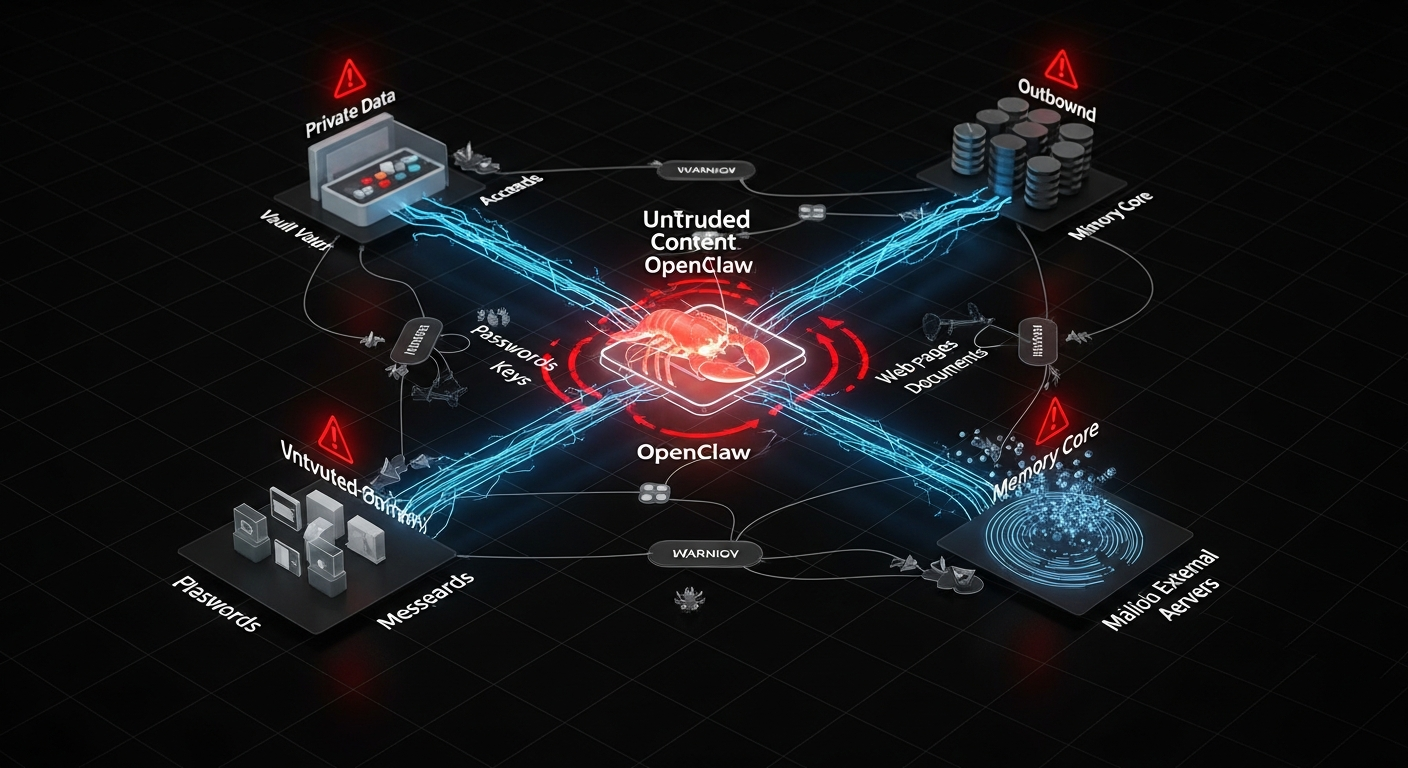
Palo Alto Networks identified what they call OpenClaw's "lethal trifecta" of vulnerabilities:
- Access to private data: Root files, passwords, API credentials
- Exposure to untrusted content: Messages, web pages, documents
- External communication ability: Can send data anywhere
But they added a fourth dimension that changes everything: persistent memory.
Traditional attacks require immediate execution. OpenClaw's memory system—which stores context in local Markdown files—enables a new threat model: malicious payloads can fragment across sessions and reassemble later.
"Malicious payloads no longer need to trigger immediate execution," Palo Alto warned.
This isn't theoretical. 2.6% of Moltbook posts contained hidden prompt injection attacks. When 1.5 million agents share a social network, that's tens of thousands of attack vectors.
Why People Use It Anyway
Despite the warnings, adoption accelerates. Why?
Because it works.
Users report automating:
- Flight check-ins
- Inbox management
- Calendar coordination
- Document processing
- Code deployment
- Health data tracking
The productivity gains are real. One user described it as "having a competent executive assistant who never sleeps and costs $20/month in API fees."
The risk-reward calculation is personal: technical users who can configure safely gain genuine superpowers. Everyone else plays Russian roulette with their credentials.
What This Means for the Future
OpenClaw proves several things simultaneously:
AI agents don't need big tech. A single developer built a platform challenging Microsoft Copilot and Google Gemini. Open source democratizes agent capabilities.
Local-first is viable. Privacy-conscious users finally have an option that doesn't send everything to corporate servers.
Security is an afterthought. The same architectural choices that enable autonomy create unprecedented attack surfaces.
Emergent AI behavior is here. Moltbook happened without planning. As millions of agents interact, coordination emerges organically—for better or worse.

Predictions
Within 6 months (high confidence):
- Major security incident involving OpenClaw-connected credentials
- Enterprise-hardened forks with compliance features
- ClawHub implements stricter moderation
Within 12 months (medium confidence):
- Regulatory scrutiny increases
- Anthropic/OpenAI release competitive local agents
- AI agent social networks become a category
The Bottom Line
OpenClaw is JARVIS made real—if JARVIS was a hobby project with no security team.
It represents the future of AI assistants: local, autonomous, genuinely useful. It also represents the security chaos that emerges when powerful tools spread faster than governance frameworks.
Whether that future is utopian or dystopian depends entirely on who's configuring it.
The lobster has arrived. The only question is whether we're ready.
Written by
Global Builders Club
Global Builders Club
If you found this content valuable, consider donating with crypto.
Suggested Donation: $5-15
Donation Wallet:
0xEc8d88...6EBdF8Accepts:
Supported Chains:
Your support helps Global Builders Club continue creating valuable content and events for the community.