The Spatial Development Revolution: Why Your Next IDE Might Be a Headset
How Vision Pro, AI coding assistants, and 3D code visualization are converging to create a new development paradigm
The Spatial Development Revolution: Why Your Next IDE Might Be a Headset
How Vision Pro, AI coding assistants, and 3D code visualization are converging to create a new development paradigm
In a study that challenged conventional wisdom about developer productivity, researchers at Paderborn University discovered something strange: developers using VR to visualize code vulnerabilities took significantly longer to complete their tasks—but reported 35 points lower frustration than those using traditional dashboards.
This counterintuitive finding hints at something bigger happening in software development. We're not just getting new tools. We're getting a new paradigm.
The Comprehension Economy
We've spent decades optimizing for typing speed. Faster keyboards. Better autocomplete. AI that writes code for you. But as AI coding assistants like Claude Code, Windsurf, and Copilot generate more code at higher speeds, a new bottleneck has emerged: understanding.
Developers increasingly work with code they didn't write—whether decades-old legacy systems, third-party libraries, or AI-generated implementations. The skill that matters isn't writing faster. It's comprehending deeper.
Enter spatial computing.
Primitive.io converts entire codebases—millions of lines—into interactive 3D structures. Teams can walk through call graphs together, navigating architecture as physical space rather than abstract text. As their developers put it, software teams succeed through their "ability to comprehend and integrate the work of many different authors."
When code becomes architecture you can walk through, integration becomes intuitive.
Apple's Trojan Horse
Apple isn't asking developers to learn spatial computing from scratch. Instead, they're extending what developers already know into a new dimension—literally.
Swift Charts 3D, announced at WWDC 2025, exemplifies this strategy. To convert a 2D chart into a 3D visualization, developers simply add a z-axis parameter:
Chart3D(data) { item in
    PointMark(
        x: .value("X Axis", item.xValue),
        y: .value("Y Axis", item.yValue),
        z: .value("Z Axis", item.zValue)
    )
}
SwiftUI extends naturally to 3D. RealityKit builds on ARKit foundations. The learning curve for iOS developers entering spatial computing is surprisingly gentle.
This is strategic brilliance. By meeting developers where they are, Apple accelerates adoption faster than forcing paradigm shifts. The immediate utility—like Mac Virtual Display turning any space into a multi-monitor setup—creates value before developers write a single line of spatial code.
Data Visualization: The Gateway Application
Tableau built a research app for Vision Pro that transforms data exploration. Their 3D globe visualizations solve projection distortion issues inherent in 2D maps—a limitation that's plagued cartography for centuries.
As their research notes: "Visualizations viewed in 3D allow people to see things that are not possible on a 2D canvas."
More significantly, eye-and-hand tracking reduce cognitive load compared to mouse and keyboard interactions. Users can explore data naturally, with detail-on-demand through intuitive gestures.
RÉCITKIT, developed by Tableau researchers, takes this further. Described as "WordPress for VR dashboards," it lets analysts build immersive data experiences by filling spatial templates with datasets—no Unity or Unreal expertise required.
Data visualization may be the "gateway drug" for enterprise spatial computing. Unlike VR coding (which faces input challenges), data exploration leverages VR's core strengths: pattern recognition, spatial memory, and intuitive navigation. Every major BI tool will likely have spatial features within two years.
The AI-Spatial Convergence
NVIDIA positions AI as "the backbone of spatial computing." Machine learning enables hand tracking, environment understanding, and contextual awareness. But the deeper opportunity lies in integrating AI coding assistants with spatial context.
Consider the trajectory:
Today: AI assistants work in text, suggesting completions and generating code
Near future: AI assistants aware of what you're looking at in spatial environments, understanding your focus and context
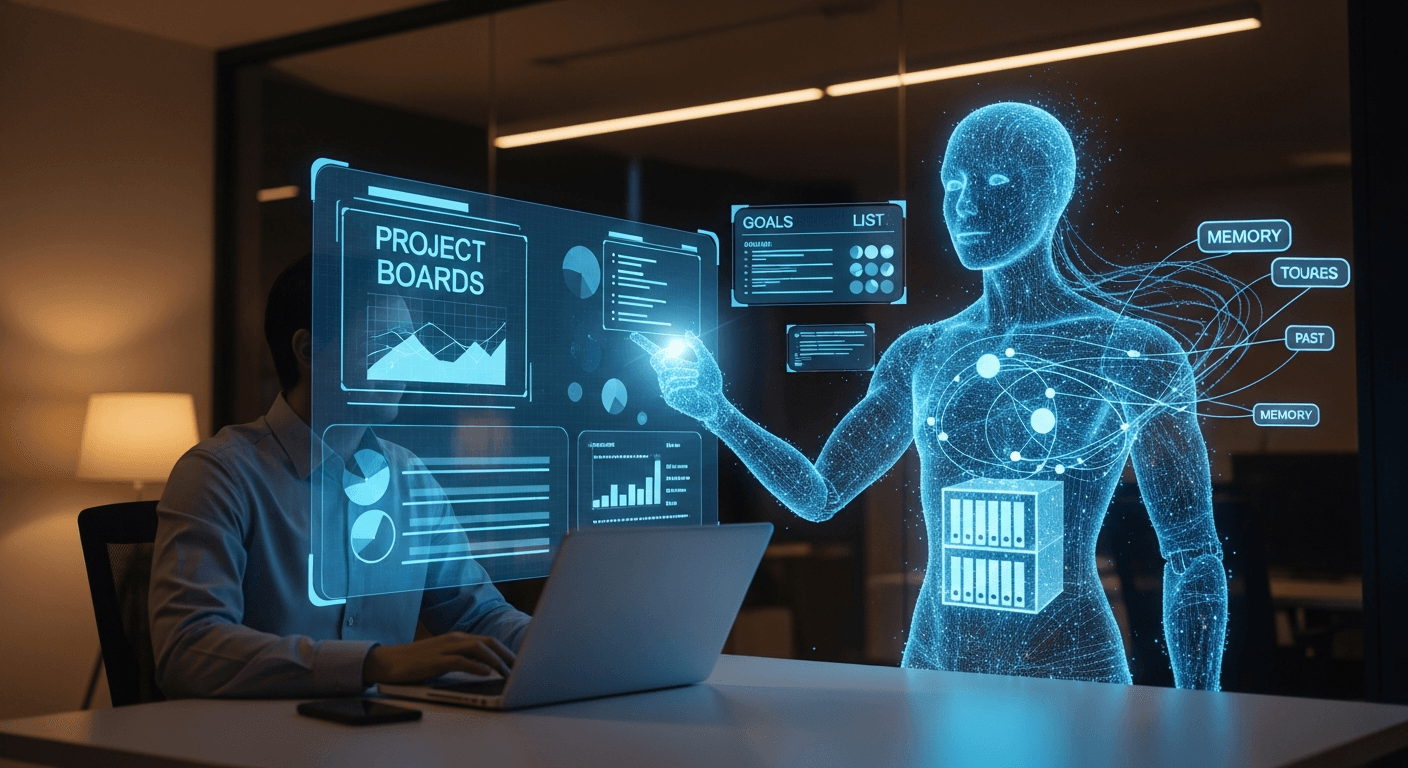
Far future: AI agents navigating codebases spatially alongside developers, pointing out connections and vulnerabilities as you explore together
The combination is multiplicative. AI handles speed—generating, refactoring, explaining. Humans use spatial tools for comprehension—seeing patterns, understanding architecture, building mental models. This isn't replacement. It's a new division of labor.
Deloitte's research predicts this endpoint: "AI agents become the interface itself." Users will express preferences through gestures, and context-aware systems will execute commands autonomously.
The $1.7 Trillion Infrastructure Gap
Gartner projects the spatial computing market will grow from $110 billion in 2023 to $1.7 trillion by 2033. Enterprise adoption is already accelerating:
- SAP Analytics Cloud runs on Vision Pro, helping executives "see data beyond the spreadsheet"
- Benfica FC tracks 2,000 data points per player in 3D simulations
- Fraser Health Authority models patient flows in digital twins
But here's what most people miss: the hardware is ahead of the infrastructure.
Deloitte's research identifies the real barrier: "Spatial data has not historically been well managed at most organizations." Companies need spatial data pipelines, production-quality development tools, and standardized formats for 3D code representation before advanced applications become feasible.
This gap is opportunity. The companies building the "picks and shovels" of spatial development—the infrastructure layer that barely exists today—will capture significant value as the market matures.
Virtual Offices and the Distributed Startup
Beyond visualization, spatial computing reshapes how teams work together.
Teamflow's founder captured the vision: "We are building the metaverse for work." Platforms like Horizon Workrooms, Spatial, and Virbela enable distributed teams to collaborate in shared virtual spaces—moving beyond grid-based video calls to something approaching physical presence.
For startups, the implications are practical:
- Reduced overhead from eliminating physical office requirements
- Collaboration that exceeds video calls without requiring co-location
- The ability to iterate on virtual spaces as easily as software
One developer documented his experience using Vision Pro on a five-hour flight: "I got more work done on these two flights than I ever had before." The 4K Mac Virtual Display provided a massive workspace without physical constraints, complete privacy, and no distraction from the cabin environment.
The Two-to-Three Year Window
Spatial computing adoption follows a clear trajectory:
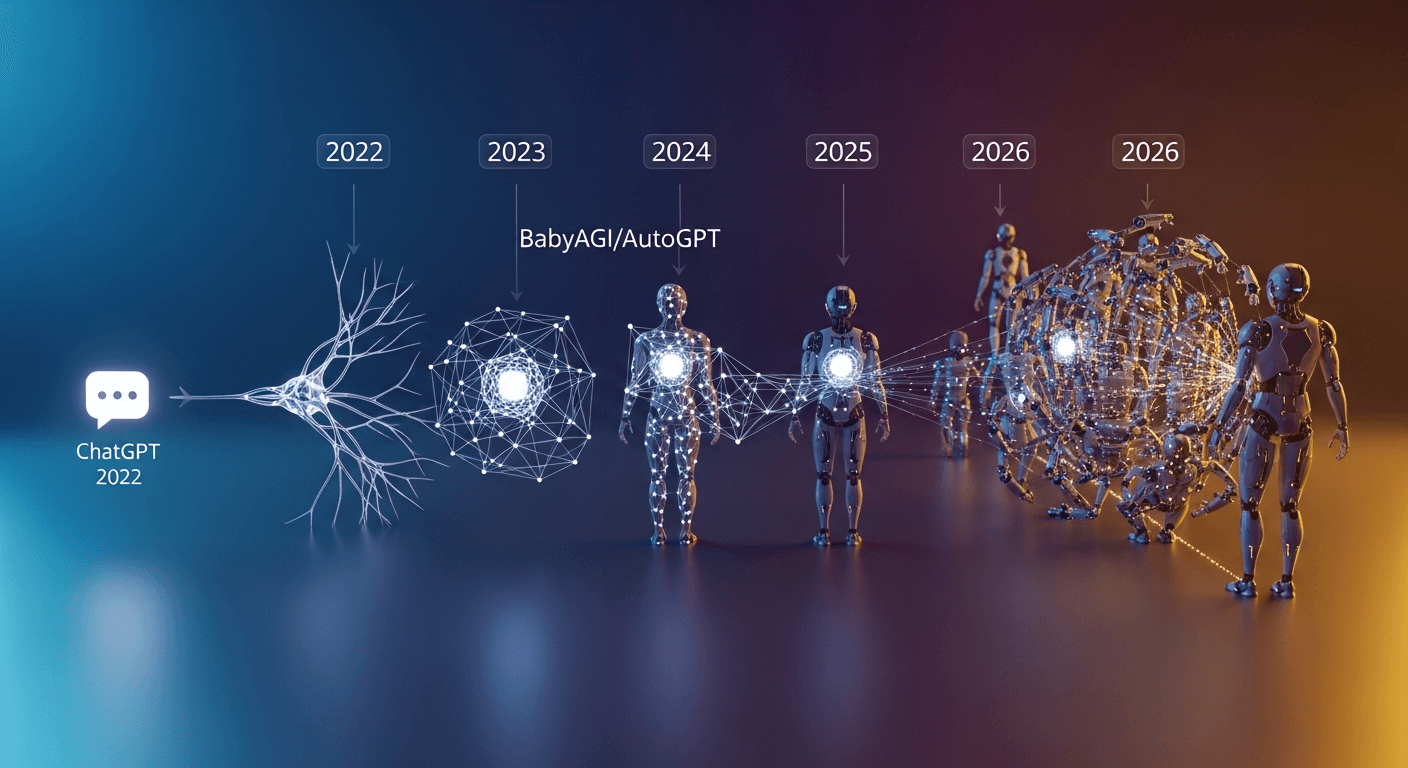
2025-2026: Enterprise adoption accelerates, particularly for training, design, and data analysis
2027-2028: Consumer applications become commonplace, with spatial interfaces preferred for complex tasks
2029-2030: Spatial computing becomes invisible infrastructure, seamlessly integrated into daily workflows
The window for first-mover advantage is closing. Developers who learn visionOS today will ship spatial apps with minimal new learning—Apple designed it that way. Founders who build spatial-native products will differentiate before the capability becomes table stakes.
What This Means For You
If you're a developer: Learn visionOS/spatial frameworks now. Focus on data visualization and comprehension tools rather than raw productivity enhancements. Experiment with AI integration in spatial contexts. Consider VR code visualization for debugging complex systems—the comprehension gains may justify the investment.
If you're building a startup: Working in VR is viable for distributed teams wanting collaboration beyond video calls. Spatial tools can differentiate products, not just enhance them. Look for infrastructure gaps—data pipelines, visualization tools, protocol explorers—as opportunities.
If you're at an enterprise: Start with data visualization. It has the lowest barrier and highest demonstrated value. Invest in spatial data infrastructure before purchasing tools. Pilot programs with Vision Pro for design, architecture, and analytics teams have clearest ROI.
The Future Isn't About Speed
Spatial computing isn't about doing things faster. It's about understanding things deeper.
In an era of AI-generated code, increasingly complex distributed systems, and codebases measured in millions of lines, that understanding may be the most valuable developer skill. The trade-off—speed for comprehension—is worth making when comprehension is the bottleneck.
The developers and companies who invest in this paradigm now—not to replace their existing workflows, but to augment them for comprehension and collaboration—will have structural advantages as the market matures.
The code of the future won't just be read. It will be walked through.
This research was compiled from 15+ sources including Apple Developer documentation, Tableau Research, Deloitte Tech Trends, academic studies, and developer experiences. For the full source list and detailed analysis, visit globalbuilders.club/blog/spatial-development-revolution.
Written by
Global Builders Club
Global Builders Club
If you found this content valuable, consider donating with crypto.
Suggested Donation: $5-15
Donation Wallet:
0xEc8d88...6EBdF8Accepts:
Supported Chains:
Your support helps Global Builders Club continue creating valuable content and events for the community.